The True Reason Behind US Hostility: Deconstructing the Century-Long Imperialist War Against Cuba

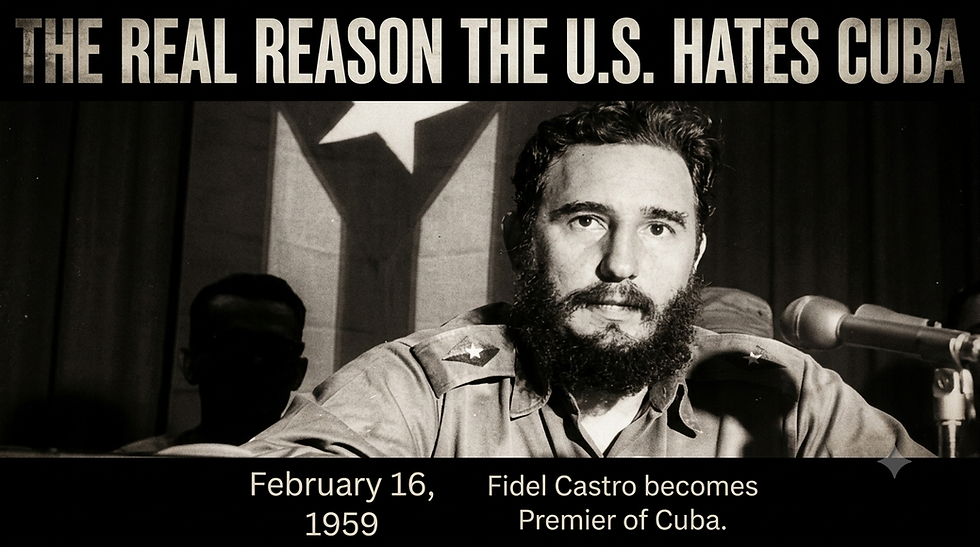
The relentless, decades-long assault on the sovereign nation of Cuba stands as one of the most glaring, unvarnished case studies of modern imperialism. For over sixty years, the foreign policy apparatus of the United States has waged an uninterrupted, unilateral war against the island. This is a war executed not with the thunder of immediate nationwide shock-and-wave invasions—though that has been attempted—but through the quiet, grinding violence of structural strangulation.
Through an all-encompassing economic blockade, the United States deliberately chokes off the material lifeblood of more than ten million civilians, actively targeting the most vulnerable strata of society, including over two million children. This systematic application of collective punishment does not merely violate the abstract tenets of international jurisprudence; it constitutes a protracted crime against humanity.
To fully understand the mechanics of this ongoing siege, one must look past the superficial platitudes of the corporate press and examine the structural dictates of global capitalism. Drawing upon the profound, enduring frameworks laid out by political scientist Dr. Michael Parenti, particularly in his seminal work The Face of Imperialism, we can strip away the ideological mystifications of the state department.
When we analyze the conflict through an anti-imperialist lens, it becomes undeniable that the tragedy inflicted upon Cuba is a calculated, structural necessity of an empire dedicated to a single, unyielding mission: making the entire globe safe for corporate exploitation, asset liquidation, and private profit maximization.
The Threat of a Socialist Example
The official rationale emanating from Washington has remained remarkably static across generations: Cuba must be punished because it is an authoritarian regime that deprives its citizens of liberty and democratic self-determination. This narrative relies heavily on the historical amnesia of the domestic populace. The empire's sudden, profound concern for the democratic rights of the Cuban people vanishes the moment one examines the historical record prior to the 1959 revolution.
For more than two decades leading up to the rebellion, successive administrations in Washington maintained exceptionally warm, lucrative, and cooperative relations with the brutally repressive military autocracy of General Fulgencio Batista. Batista’s regime routinely tortured, disappeared, and murdered political dissidents while maintaining a society starkly divided along class and racial lines. Yet, Washington never saw fit to impose a blockade on Batista, nor did the American press demonize him as a pariah. Instead, he was supplied with American arms, applauded by American financiers, and embraced as a stalwart ally.
The fundamental difference between General Batista and Fidel Castro did not lie in their adherence to democratic norms, but in their relationship to transnational capital. Under Batista, Cuba operated as a pristine, hyper-exploited satellite state of the American empire. Its vast sugar plantations, lucrative tobacco industries, mineral-rich nickel mines, utilities, and legendary tourism sectors were overwhelmingly owned by US corporations and a small, deeply corrupt domestic comprador class.
When the July 26th Movement overthrew this corporate paradise in 1959, the new revolutionary government committed the ultimate sin: it prioritized the material needs of its own people over the profit margins of foreign monopolies.
By enacting sweeping agrarian reforms, expropriating millions of acres of prime land from corporate entities like the United Fruit Company, and nationalizing the banking, industrial, and commercial sectors, Cuba broke away from the dictates of the free-market system. It reoriented its entire socio-economic architecture toward a not-for-profit, socialist model aimed at human development.
This redistribution of surplus wealth—guaranteeing fundamental rights to healthcare, housing, employment, and literacy—posed an existential threat to the logic of global imperialism. The US state department could not allow such an alternative to succeed. If a small, resource-poor island just ninety miles from Key West could successfully build a society independent of corporate exploitation, it would serve as a dangerous, infectious example to the rest of the colonized, hyper-exploited Global South. Cuba had to be destroyed, not because it failed, but because it dared to try something different.
The Imperialist Modus Operandi
The campaign launched against Cuba provides a comprehensive look at the imperialist playbook for regime change. When a nation steps outside the boundaries of the global capitalist order, the National Security State deploys a sophisticated, multifaceted apparatus of subversion designed to erode the target state from within and without. This modus operandi follows a highly calculated sequence of economic, psychological, and military interventions.
First, the revolutionary or reformist leadership must be systematically demonized. The corporate media, operating in lockstep with intelligence agencies, begins a coordinated campaign to paint the leaders of the target nation as fanatical, bloodthirsty, power-hungry tyrants or even mentally unstable actors. This psychological warfare strips away the political legitimacy of their social project, rendering any subsequent acts of imperialist violence seemingly defensive and morally justified.
Second, the empire deploys its most devastating weapon of mass destruction: asymmetric economic warfare. Comprehensive sanctions and trade embargoes are enacted with the explicit, unclassified intent to inflict maximum suffering on the civilian populace. As presidential administrations have openly admitted in internal documents, the goal is to purposefully cripple the domestic economy, trigger widespread shortages of vital goods, and "make the economy scream". The underlying theory is deeply cynical: by creating artificial misery and starvation, the empire hopes to manipulate the civilian population into rising up and overthrowing their own government.
Third, under the guise of supporting "civil society," the empire funnels millions of dollars to domestic subversive elements, mercenary proxies, and exile groups. If the economic blockade fails to trigger an internal collapse, the military apparatus is engaged. In the case of Cuba, this took the form of covert operations, state-sponsored sabotage, industrial arson, hundreds of assassination plots against leadership, and the catastrophic, CIA-financed proxy invasion at the Bay of Pigs in 1961.
When the target nation naturally responds by tightening internal security and arresting those acting as agents for a foreign power, the empire closes the trap, using those defensive measures as ultimate proof that the regime is uniquely dictatorial.
Media Deception and Non-Falsifiable Stances
This entire geopolitical siege is sustained by the sophisticated complicity of the corporate media ecosystem. The mainstream press does not act as an independent watchdog, but as an ideological shield for imperial interests, utilizing deep self-censorship to shape public perception. During the lead-up to the Bay of Pigs invasion, major American newspapers and wire services actively suppressed detailed reports outlining the CIA's extensive military preparations. When Cuban leadership publicly warned that an invasion was imminent, the mainstream press dismissed the charges as ridiculous, shrill communist propaganda—only for the invasion to materialize exactly as predicted days later.
Furthermore, the media reinforces a completely non-falsifiable framework regarding Cuba's diplomatic stance. Within this ideological echo chamber, the empire's hostility is entirely immune to empirical counter-evidence. The state department's position relies on an aggressive logical trap where both a given condition (A) and its exact opposite (not A) are used to justify the identical policy of hostile rigidity.
For instance, if Cuban officials aggressively condemn American imperial overreach and sabotage, the media trumpets this as absolute proof of Cuba's inherent anti-Americanism and danger to regional peace. Conversely, when the Cuban government extends a diplomatic olive branch, offers concessions, and repeatedly requests normalized relations and peaceful co-existence, the media framing morphs instantly.
The friendly posture is immediately labeled a deceptive psychological ploy, a cynical manipulation, or a sign of weakness from a sneaky adversary. Because the empire can never allow its core motive—the destruction of an anti-capitalist state—to be debated, the media ensures that no action by the victim can ever falsify the narrative of the aggressor.
Human Toll and Double Standards
The human cost of this non-falsifiable geopolitical stance is staggering. Because of the unilateral blockade, Cuba is burdened with the highest import and export transport costs of any nation on earth. Rather than trading with its natural geographic partner just miles away, it must source school buses, industrial machinery, and basic agricultural inputs from distant continents.
Most catastrophically, the blockade restricts the smooth acquisition of lifesaving medicines, medical technology, and raw materials required for public healthcare infrastructure. This is a calculated choice by Washington to weaponize basic human survival as a mechanism for regime change.
This ongoing cruelty is accompanied by an array of grotesque international double standards. Consider the imperial narrative surrounding immigration. When economic conditions deteriorate in Cuba—conditions purposefully engineered by the American blockade—and citizens choose to leave, the Western media holds this up as definitive proof of the complete failure of socialism and the repressive nature of the state.
Yet, millions of desperate migrants flee capitalist nations throughout the Global South—such as Haiti, Colombia, Honduras, and the Philippines—every single year due to crushing poverty, gang warfare, and state neglect. The corporate press never presents this massive exodus as a reason to question the moral legitimacy or economic efficacy of the free-market system.
The most blatant manifestation of this hypocrisy lies in the domain of state-sponsored terrorism. While the United States continually lectures the world on the necessity of a global war on terror, it has historically provided safe haven, financial support, and legal protection to right-wing, anti-Castro terrorists. Notorious mass murderers like Orlando Bosch and Luis Posada Carriles—who openly admitted to orchestrating the horrific 1976 bombing of a civilian Cuban airliner, killing all 76 people on board—lived out their lives in absolute comfort and safety in Miami, shielded from extradition by the US government.
In sharp contrast, when Cuba sent five intelligence agents to Florida strictly to monitor and infiltrate these extreme exile cells to prevent further tourist hotel bombings in Havana, the US government arrested them. These men, known as the Cuban Five, committed no acts of industrial sabotage or physical espionage against the US state; their only mission was to defend their homeland from illegal, Florida-based terror networks. They were thrown into federal prisons for over a decade.
Capitalism Without Democracy
The enduring tragedy of the war on Cuba exposes the real hierarchy of values governing the imperialist core. The elite classes who direct Western foreign policy are entirely indifferent to abstract definitions of liberty, human rights, or democratic governance. This reality was inadvertently laid bare in a letter from Lee Hamilton, then-chair of the House Foreign Affairs Committee, who acknowledged that the true objective of the blockade was to retaliate for the historical seizure of American corporate assets and to force Cuba into the practices of a free-market system.
The lesson of Dr. Michael Parenti’s analysis is as urgent today as it was at the height of the Cold War: when forced to choose between democracy without capitalism or capitalism without democracy, the builders of empires will unhesitatingly choose the latter. They will eagerly tolerate, fund, and install the most murderous military dictatorships imaginable if those regimes open up their borders to transnational corporate penetration.
What they will never tolerate is a sovereign, self-determining population that takes its resources into its own hands, organizing its society around human solidarity rather than private accumulation. The ongoing siege of Cuba remains a testament to the lengths to which global capital will go to stomp out the slightest glimpse of a socialist alternative.


Comments