How Cori Bush's Underwhelming 1st Term in Office Paved the Way for Her Loss in Her Comeback Bid for Congress
- Unplug The Empire

- Aug 5
- 4 min read
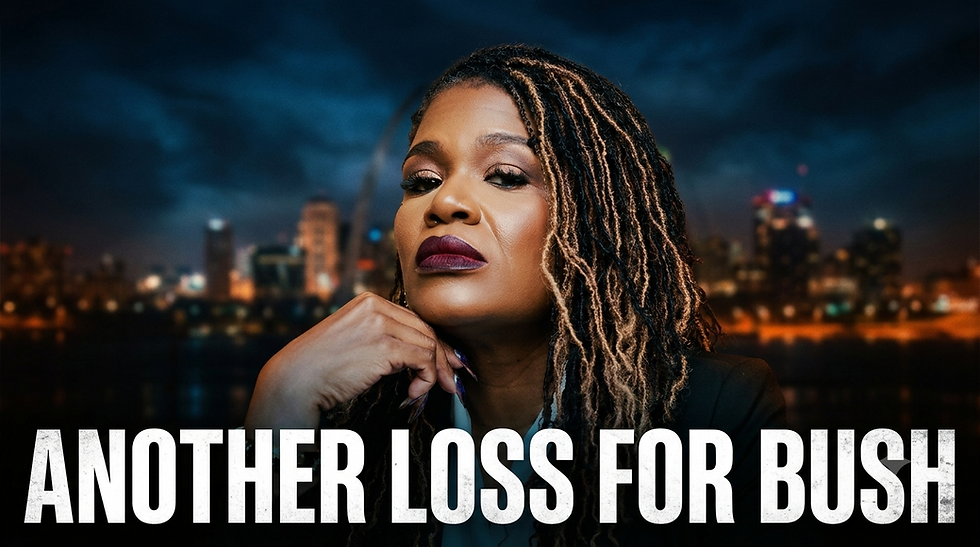
When Cori Bush unseated political dynast Lacy Clay in 2020, working-class St. Louis sent a clear signal: the district was hungry for principled, anti-imperialist leadership that would fight directly for working families. Bush emerged from the streets of Ferguson as a nurse, pastor, and activist who promised to break the cycle of corporate Democratic compromise.
Fast forward to the August 2026 Democratic primary, where Bush’s rematch against Representative Wesley Bell resulted in a resounding 59.2% to 36.9% defeat.
Corporate media and progressive campaign apparatuses will blame her second loss entirely on the millions funneled into the race by the American Israel Public Affairs Committee (AIPAC). But reducing Bush’s political collapse to outside lobby spending ignores a fundamental truth that socialist and working-class organizers must confront: Cori Bush lost her comeback bid because her time in office disappointed the very people who put her there.
Once working-class voters in Missouri’s 1st District got a real "taste" of Bush in office, they realized that her radical activist roots had been traded in for performative liberalism.
From Grassroots Activist to Book-Writing Liberal
The fundamental tragedy of Cori Bush’s tenure was her swift absorption into the institutional ecosystem of Washington, D.C. Rather than acting as a class-conscious tribune for working-class Missourians, Bush aligned herself with the parliamentary strategy pioneered by Alexandria Ocasio-Cortez (AOC) and "The Squad".
This strategy promised to press the Democratic establishment from the inside. In practice, it turned anti-establishment activists into virtue-signaling liberals who protected the party leadership whenever structural fights mattered most.
The transformation was striking. Bush went from leading sleep-ins on the Capitol steps to writing memoirs, appearing on liberal media circuits, and adopting the sterile language of non-profit careerism.
The Moral Paradox: While in office, Bush spoke the language of systemic transformation, yet her actual parliamentary record mirrored the foreign and domestic priorities of the Democratic leadership.
Loss of Grounding: Outside of campaign cycles, she struggled to articulate core material policies under basic media questioning—frequently failing to clearly explain socialist tax policies or detail working-class economic relief plans without relying on non-profit buzzwords.
A Record That Betrayed the Working Class
For socialists and anti-imperialists, a Representative’s voting record is the definitive test of class commitment. Bush’s legislative performance repeatedly failed that test:
1. Breaking the Railroad Workers' Strike
In late 2022, when tens of thousands of freight rail workers prepared to strike for paid sick leave and safe working conditions, the Biden administration moved to outlaw their strike and force a contract upon them. Bush joined the majority of the House in voting to crush the union's primary bargaining leverage, siding with corporate rail monopolies over the working class.
2. Funding the Imperial War Machine
Despite running as an anti-imperialist, Bush repeatedly voted in favor of massive military spending packages, including funding for NATO expansion and billions in military aid for foreign proxy conflicts. While her rhetoric opposed war, her official votes authorized the expansion of the US security state.
3. Compromising on Domestic Infrastructure
Bush made headline-grabbing votes against the bipartisan Infrastructure Investment and Jobs Act—claiming she opposed it because it was decoupled from broader social welfare spending. Yet when the political heat intensified, her legislative maneuvering failed to secure any of the promised material expansions for housing, public education, or healthcare for St. Louis.
Misreading the Material Realities of St. Louis
As political analysis from Black Agenda Report pointed out following her early campaign attempts, Missouri's 1st District is not the Bronx or a gentrified enclave. MO-01 is a 50% Black, deeply working-class district where political power is tied to tangible material conditions: job security, infrastructure, neighborhood survival, and community institutions.
While Bush focused on national media narratives, her office fell out of touch with the local working-class infrastructure. She failed to build sustainable, independent mutual-aid networks or deliver direct material relief to the district. When local crises struck—such as severe weather events and infrastructure collapse—working-class residents felt her office was more focused on national branding than local survival.
Furthermore, persistent ethics distractions—including a federal investigation into her campaign's security spending—eroded her credibility as a working-class candidate operating on a moral high ground.
The Lesson: Rebuilding an Independent Working-Class Movement
In her concession speeches, Bush claimed that losing election bids "took the strings off" and "radicalized" her. The Socialist YouTube channel, Revolutionary Blackout Network, offered a sharp rebuttal to that narrative: Working-class representatives should hold firm socialist principles while in power, not promise to find their principles only after voters kick them out.
The defeat of Cori Bush’s 2026 comeback bid offers a clear lesson for the left:
The Strategy of Reforming the Democratic Party is Dead: Funneling millions of dollars and grassroots energy into primarying Democrats inside a bourgeois party apparatus yields performative politicians who ultimately bow to party discipline.
Prioritize Material Organization Over Electoral Drama: Real power is built on the ground—through independent worker unions, anti-war coalitions, tenant unions, and direct mutual aid networks that deliver material survival to working-class families regardless of who holds office.
Cori Bush’s loss was not an accident, nor was it solely the work of outside Super PACs. It was the natural outcome of a representative who lost touch with her class base. For the socialist movement to move forward, it must stop investing in virtue-signaling careerists inside the Democratic Party and return to the hard, unglamorous work of building independent working-class power.


Comments