The Toxic Footprint of NATO: Military Bases as Permanent Occupations
- Unplug The Empire

- 7 days ago
- 6 min read
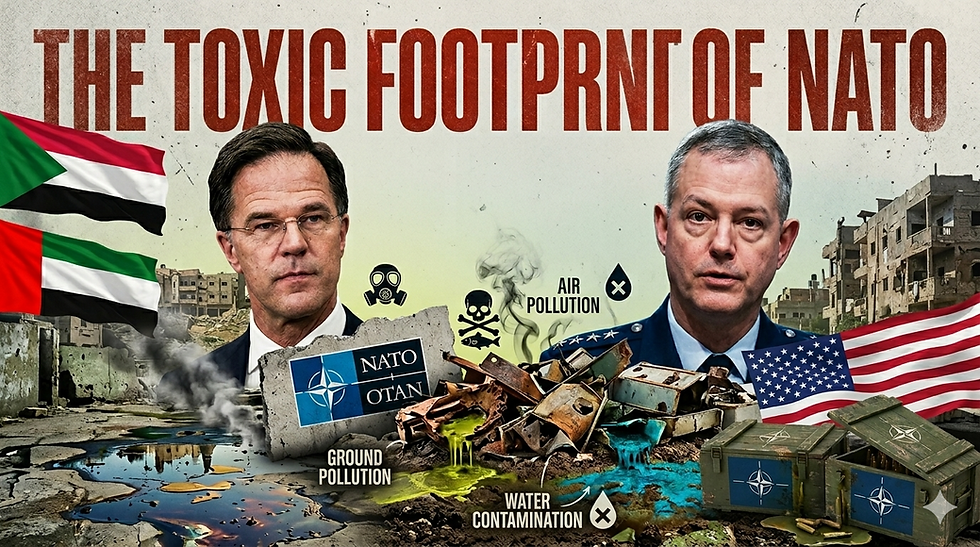
For decades, the presence of NATO and U.S. military bases around the world has been sold to the public as a "shield"—a necessary infrastructure for global peace and collective defense. But for the people living in the shadows of these installations, from the islands of the Pacific to the heart of Europe and the coastlines of Africa, the reality is far from protective. These bases are not mere outposts of security; they are the "tentacles" of a global empire that exerts a permanent, destructive occupation on local communities.
Even during "peacetime," these bases function as engines of environmental ruin, public health crises, and the systematic erasure of indigenous sovereignty. To understand the true cost of NATO’s global reach, we must look past the flags and the uniforms and examine the "toxic footprint" left behind in the soil, the water, and the very bodies of those who live nearby.
The Chemical Warfare of Peacetime: PFAS and Water Poisoning
One of the most insidious legacies of NATO-aligned military bases is the widespread contamination of local water supplies with per- and polyfluoroalkyl substances (PFAS), often referred to as "forever chemicals." These chemicals are a primary ingredient in aqueous film-forming foam (AFFF), used by the military for decades in firefighting drills.
Because PFAS do not break down in the environment, they seep into the groundwater, contaminating the drinking water of millions. This is not a localized issue; it is a global phenomenon linked to nearly every major U.S. and NATO installation.
Case Study: Okinawa, Japan
In Okinawa—often called the "Keystone of the Pacific" due to its dense concentration of U.S. bases—the contamination has reached crisis levels. Monitoring near Kadena Air Base and Marine Corps Air Station Futenma has revealed PFAS levels hundreds of times higher than safety guidelines. For the Okinawan people, this is a form of "slow-motion chemical warfare." High levels of these chemicals are linked to kidney cancer, thyroid disease, and developmental issues in children. Despite decades of local protest, the military’s "Status of Forces Agreements" (SOFA) often grant them immunity from local environmental laws, leaving the Okinawan people to drink poisoned water while the "defenders" remain unaccountable.
The European Contamination
In Germany, home to some of the largest NATO hubs like Ramstein Air Base, the soil and water surrounding these facilities are riddled with toxins. The cost of cleaning up these "forever chemicals" is estimated in the billions, yet the burden often falls on local taxpayers rather than the military entity that caused the damage. This is the "rules-based order" in practice: NATO creates the waste, and the host nation pays the price in both health and currency.
The Slow Poisoning of Soldiers and Civilians
While PFAS represents a liquid threat, "burn pits" represent an airborne one. For years, military bases in conflict zones and "enduring" locations have disposed of vast quantities of waste—including plastics, electronics, medical waste, and chemicals—by dousing them in jet fuel and setting them ablaze in massive open-air pits.
The resulting black smoke contains dioxins, particulate matter, and other carcinogens. While much of the media attention has focused on the health of returning Western veterans, the impact on the local civilian populations living downwind is often ignored.
The Atmospheric Toll: In places like Iraq and Afghanistan, where NATO bases operated for two decades, the air quality near these installations was permanently degraded. Local families reported skyrocketing rates of respiratory illness, skin conditions, and rare cancers.
The Ecological Cycle: The ash from these pits settles on crops and enters the food chain. This creates a cycle of toxicity that lasts long after the base is closed or the "mission" is declared over. It is a permanent occupation of the very air the local population breathes.
Displacement of Indigenous Peoples
The "toxic footprint" of NATO is not just chemical; it is social and political. The establishment of these bases frequently requires the forced removal of indigenous populations, turning ancestral lands into "strategic assets" where the original inhabitants are no longer welcome.
The Tragedy of Diego Garcia (Chagos Islands)
Perhaps the most egregious example is the Chagos Archipelago. In the 1960s and 70s, the United Kingdom—a founding NATO member—secretly and forcibly expelled the entire Chagosian population to make way for a massive U.S. naval and air base on the island of Diego Garcia.
The Chagosians were dumped in the slums of Mauritius and the Seychelles, their pets were gassed, and their homes were barred. Today, Diego Garcia is a critical hub for NATO-linked operations in the Middle East and Indian Ocean, yet the people who lived there for generations are still fighting for the right to return. This is the "defense of democracy" built on the bones of a displaced and disenfranchised people.
Greenland and the Arctic Frontier
As NATO pivots toward the Arctic, the indigenous Inuit populations of Greenland face similar pressures. The Thule Air Base (now Pituffik Space Base) has a long history of displacing local hunters and leaving behind radioactive waste from Cold War-era accidents. As the alliance "securitizes" the North, the sovereignty of indigenous people is treated as an obstacle to be managed rather than a right to be respected.
The "Tentacles" of Empire: A Global Network of Harm
To visualize NATO’s presence as a "shield" is a failure of perspective. If we look at a map of the hundreds of bases stretching from South America (via "partnerships") to the edges of Eastern Europe and the African continent, they look more like tentacles. These tentacles extract resources, monitor populations, and ensure that the host nations remain tethered to the geopolitical interests of the alliance's leaders.
The Social Decay of "Base Towns"
Beyond environmental toxins, the presence of large military bases often brings a specific kind of social destruction to local communities:
The "Base Economy": Local industries are often gutted in favor of service economies that cater solely to soldiers (bars, brothels, and predatory lending). This creates a cycle of economic dependency.
Violence and Crime: In places like South Korea and the Philippines, the history of U.S. and NATO-linked bases is marred by cases of sexual violence and crimes committed by servicemen who are then shielded from local prosecution by SOFA agreements. This creates a "legal black hole" where the "defenders" are essentially above the law of the people they are supposedly protecting.
Peacetime is a Myth for the Occupied
We are told that we live in an era of "peace" among the great powers, but for those living near a NATO base, there is no peace. There is only the constant roar of jet engines, the fear of contaminated wells, and the humiliation of seeing their land used as a staging ground for wars they did not vote for.
A base is a "permanent occupation" because it never truly sleeps. It constantly consumes energy, produces waste, and projects power. Even if a shot is never fired from its gates, the base is an active participant in the destruction of the local environment and the suppression of local sovereignty.
The Ecological Cost of "Readiness"
The military is one of the world's largest consumers of fossil fuels. If the U.S. military—the core of NATO—were a country, it would be the 47th largest emitter of greenhouse gases in the world. This carbon footprint is a global threat that NATO contributes to every single day through its training exercises and "forward positioning." We are destroying the planet's climate in the name of "defending" it.
Dismantling the Infrastructure of Empire
The "Toxic Footprint" of NATO’s military bases proves that the alliance’s costs are not just measured in defense budgets, but in the degradation of the Earth and the violation of human rights. These bases are the physical manifestation of a unipolar world—a world where the safety of the "core" is bought with the health and land of the "periphery."
To be truly anti-imperialist is to recognize that "defense" should not require the poisoning of water in Okinawa, the displacement of families in Chagos, or the burning of toxic waste in Iraq.
The arithmetic of the "rules-based order" always results in a deficit for the poor and the colonized. It is time to stop viewing these installations as symbols of security and start seeing them for what they are: toxic anchors that hold back the progress of sovereign nations and destroy the very environment we all depend on for survival. The first step toward a peaceful and sustainable world is not more bases, but the dismantling of the infrastructure of empire.


Comments