Breaking the Duopoly: Inside Kshama Sawant’s Revolutionary Campaign to Disrupt Congress
- Unplug The Empire

- 4 days ago
- 7 min read
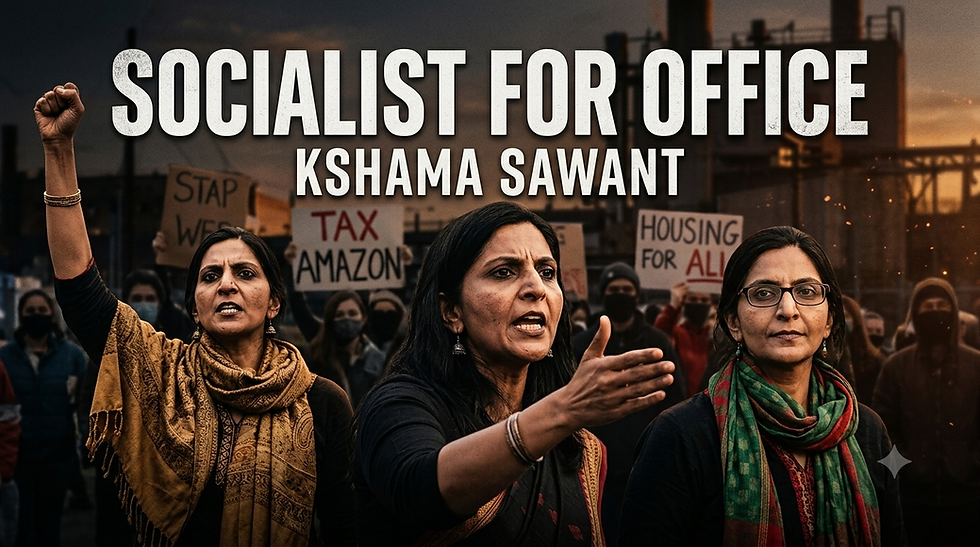
For nearly thirty years, Washington state’s 9th congressional district has been represented by Representative Adam Smith—a reliable fixture of the Democratic Party establishment. To his critics, Smith embodies the ultimate political insider: a powerful member of the House Armed Services Committee, a steady recipient of corporate campaign contributions, and an unwavering supporter of foreign military interventions. For decades, the political calculus in this left-leaning district, which spans south Seattle down through the suburbs of Bellevue and Tacoma, has suggested that a well-funded incumbent Democrat is virtually untouchable.
But as the 2026 primary season approaches, a fundamentally different kind of political challenge has emerged. Kshama Sawant, the fiercely unapologetic revolutionary socialist who spent a decade shaking up Seattle City Hall, has launched an independent bid for the seat. Her objective is not merely to win a campaign, but to use the halls of Congress to build an entirely new framework for working-class resistance.
In a wide-ranging, deeply critical interview on The Chris Hedges Report, Sawant and veteran journalist Chris Hedges laid bare the architectural mechanics of what they term the "corporate duopoly"—the bipartisan system governing American politics. The discussion provided an explicit autopsy of the modern Democratic Party, a scathing critique of establishment labor leadership, and a detailed blueprint for how grassroots movements can successfully force concessions from the billionaire class.
A Platform Born of National Emergency
Sawant’s decision to run for Congress is driven by what she characterizes as a structural breakdown affecting both domestic and international life. "We are in a national and international emergency for the working class, for the planet," Sawant told Hedges. Pointing to the stark reality that half of the American population reports struggling to afford everyday groceries in the wealthiest nation in human history, Sawant frames her platform not as a wishlist of progressive ideals, but as an urgent set of non-negotiable demands.
At the core of her platform is a sweeping redistribution of wealth and an aggressive pivot in foreign policy. Internationally, Sawant calls for an immediate and total cessation of all United States military aid to the Israeli state, condemning the ongoing violence in Gaza, Lebanon, and across the Middle East as an unchecked humanitarian catastrophe bankrolled by American taxpayers. Domestically, her anti-imperialist framework extends to the dismantling of Immigration and Customs Enforcement (ICE) and the closure of its regional detention centers—agencies she points out were expanded and consistently funded under both Democratic and Republican administrations.
                  SAWANT'S CONGRESSIONAL PLATFORM
┌───────────────────────────────┬───────────────────────────────┐
│        ECONOMIC MANDATES      │   SOCIAL & IMMIGRATION REFORM │
├───────────────────────────────┼───────────────────────────────┤
│ • $25/Hour National Minimum   │ • Defend LGBTQ+ Rights        │
│   Wage                        │   & Oppose Anti-Trans Bills   │
│ • Universal Medicare for All  │ • Full, Unrestricted          │
│ • Comprehensive Federal Rent  │   Abortion Access             │
│   Control                     │ • Shut Down ICE & Federal     │
│ • Tax Corporate Wealth for    │   Detention Centers           │
│   Public Affordable Housing   │ • Community Control of Police │
└───────────────────────────────┴───────────────────────────────┘
On the economic front, Sawant is running on a national minimum wage of $25 per hour, comprehensive federal rent control tied strictly to inflation, and a massive expansion of publicly owned, high-quality affordable housing funded directly by taxing massive corporations. Her healthcare plan bypasses standard incremental modifications to the Affordable Care Act, calling instead for a state-of-the-art "Medicare for All" system that is publicly owned and democratically run by working people, entirely removing the profit motive from medicine. Furthermore, to combat what she describes as an impending "climate apocalypse," Sawant advocates for a massive green jobs program alongside the public ownership of major energy conglomerates, arguing that private energy bosses inherently profit from ecological exploitation.
Unmasking the Corporate Duopoly and Its "Gatekeepers"
A central thesis of Sawant’s campaign is that the two major political parties are structurally incapable of serving the public interest. She argues that the corporate media works tirelessly to maintain the illusion of a "lesser evil," a myth she explicitly rejects. According to Sawant, the Democratic Party is not an alternative to global capitalism; it is one of its two primary engines.
To illustrate this systemic betrayal, Sawant and Hedges detailed the concept of political "gatekeepers"—figures inside progressive institutions who exist to domesticate unrest and redirect it back into safe, corporate-approved electoral channels. Sawant reserved some of her sharpest criticisms for mainstream labor leadership and what she terms "business unionism."
"An overwhelming majority of the labor leadership has made peace with the bosses and their political parties," Sawant observed.
She cited a striking historical failure: the fact that most contemporary union contracts include legally binding "no-strike" clauses. By signing away the right to strike—the working class’s single most potent weapon to stop the corporate profit machine—labor leaders have functionally neutered rank-and-file power. She recalled how during mass protests against ICE terror in Minneapolis, labor officials spent energy sending cautionary emails about contract penalties rather than organizing solidarity actions, highlighting a profound disconnect between workers and union executives.
The domestication of the political left is not limited to union boards; it is rampant within the halls of Congress itself. Sawant pointed directly to figures like Representative Alexandria Ocasio-Cortez (AOC) and the Congressional Progressive Caucus as cautionary examples. She reminded viewers of the early 2021 "Force the Vote" initiative, where progressives held the numerical balance of power to withhold their votes for Nancy Pelosi's speakership unless they were guaranteed a floor vote on Medicare for All. The Progressive Caucus refused to wield its leverage.
Sawant noted that in a later moment of candor, AOC admitted she avoided the tactic because she feared "relational and reputational harm" within the party structure. To Sawant, this admission exposes the fatal flaw of mainstream progressivism: prioritizing a comfortable seat at the establishment table over the needs of the working class. "If you are fighting for the working class, you will become enemy number one of the Democratic Party," Sawant stated, arguing that such friction should be embraced as a badge of honor, not avoided.
The Battlefield of Washington's 9th District
The political landscape of the 9th congressional district offers a clear study in how the establishment defends itself against systemic threats. Sawant’s chief opponent, Adam Smith, has spent nearly three decades building a career that bridges the gap between the Democratic establishment and right-wing policy preferences. Sawant pointed out that Smith was one of only five House Democrats who voted for the initial invasion of Iraq, has consistently authorized tens of billions of dollars in foreign military aid, and recently voted to block United States food assistance to Gaza. Furthermore, his campaign has historically relied on significant financial backing from major military defense contractors, aerospace companies, and pro-Israel lobbying groups like AIPAC.
Yet, because Smith’s hawkish and pro-billionaire record makes him increasingly difficult to market to a deeply progressive base, Sawant argues that the Democratic establishment has deployed a familiar secondary strategy: introducing a curated alternative candidate to dilute the left-wing vote.
In this race, that role is filled by another Democrat, Melissa Chaudhry. While Chaudhry is frequently perceived as a progressive option due to her personal identity and community background, Sawant notes that her platform carefully sanitizes its language to avoid challenging the party hierarchy. Explicit terms like "genocide," "occupation," "Israel," or "Palestine" are entirely missing from Chaudhry’s campaign literature and public messaging.
Even more alarming to Sawant is Chaudhry’s calculated omission of protections for the LGBTQ+ community and abortion rights—a choice Sawant views as a massive betrayal given that Washington voters face severe right-wing ballot initiatives aimed at stripping trans protections. Sawant compared Chaudhry’s structural role to that of Senator Elizabeth Warren in the 2020 Democratic Presidential primary, who remained in the race just long enough to split the progressive vote and clear a smooth path for Joe Biden.
The collaborative effort to suppress an independent left option went even further. Sawant revealed that the lone major Republican candidate in the race openly admitted to being actively recruited by political operatives to enter the primary. The explicit strategy was not to mount a serious challenge against Adam Smith, but rather to split the anti-incumbent vote and block Sawant from finishing in the top two positions, thereby preventing a revolutionary socialist from reaching the general election ballot entirely.
Movement over Careerism
For Sawant, entering an electoral race is never about securing a personal career. Throughout her decade on the Seattle City Council, she consistently donated the vast majority of her salary to a solidarity fund dedicated to social movements, living on only a fraction of her city income. This absolute rejection of careerism is what allowed her office to operate with unprecedented independence.
When Sawant first took office in January 2014, senior Democratic council members sat her down and delivered a blunt warning: City Hall runs on our terms, and you will not win a minimum wage increase. Less than six months later, Seattle became the first major city in America to pass a historic $15 per hour minimum wage ordinance.
How was this accomplished? Sawant explains that she did not win by mastering backroom negotiations or trying to be a "team player" with her council colleagues. Instead, she used her elected position as a megaphone to launch the "15 Now" grassroots movement, organizing thousands of workers, staging rallies, and threatening a direct ballot initiative that big business could not control.
Faced with an organized and disruptive populace, the Chamber of Commerce and the city's political establishment were forced to concede. She repeated this exact outsider strategy to pass the "Tax Amazon" legislation in 2020, defying both corporate real estate interests and non-governmental organization (NGO) gatekeepers by collecting 30,000 community signatures in just three months to present an undeniable electoral threat to corporate giants like Jeff Bezos.
"Elected offices under capitalism do not exist to give working-class people better lives," Sawant emphasized to Hedges. "They exist to defend capitalist interests." Therefore, the only way an institutional seat can serve a transformative purpose is if it is occupied by an organizer who answers exclusively to mass movements outside the building.
The Path to the General Election
The upcoming primary election stands as a critical structural hurdle. Because Washington employs a top-two primary system, voters will cast ballots for all candidates regardless of party affiliation, and only the top two finishers will advance to the November ballot.
The Democratic establishment’s primary objective is to engineer a voting split that keeps Sawant out of the general election entirely. They understand that a head-to-head matchup between an incumbent corporate Democrat and an unyielding revolutionary socialist would fundamentally change the terms of political debate in the region, exponentially increasing the likelihood of an establishment defeat.
Despite a comprehensive corporate media blackout and identical resistance from progressive outlets that reject third-party organizing, Sawant's campaign has built an impressive financial and organizational base. Operating strictly through her national coalition, Worker Strike Back, the campaign has successfully raised over $600,000. Crucially, this sum consists entirely of grassroots, small-dollar donations coming from all fifty states, Washington D.C., and Puerto Rico. On the ground within the district, Sawant’s campaign boasts eight and a half times more individual donations than Adam Smith, whose war chest relies almost exclusively on corporate
As the conversation concluded, both Hedges and Sawant framed the campaign as a vital test case for the future of independent left politics in America. For working-class people exhausted by systemic gridlock, rising inflation, and endless foreign conflicts, the race in Washington’s 9th district is no longer a localized contest—it has become a national battleground to prove that corporate power can be challenged and defeated at the ballot box.


Comments