A 250-Year-Old Promise: Why Capitalism Cannot Deliver the Promises of July 4th, 1776

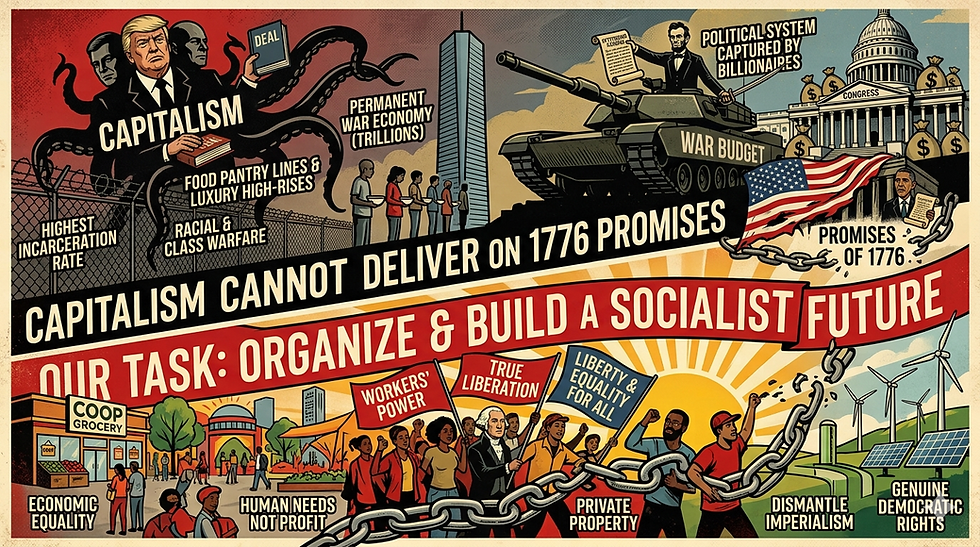
As the United States approaches its 250th anniversary, the air is thick with a familiar, manufactured nostalgia. We are about to be subjected to a multi-billion-dollar marketing campaign of national self-congratulation. Red, white, and blue banners will drape corporate headquarters; politicians will deliver rehearsed speeches about the "enduring miracle of American democracy"; and mainstream media will spin a comforting yarn about a nation that, despite a few historic "bumps in the road," has spent two and a half centuries marching steadily toward freedom.
But for those who look at the world through an anti-imperialist, anti-capitalist lens, this milestone hits differently. We don't see a completed masterpiece of liberty. We see a profound crisis.
We look at a country with the highest incarceration rate in the world, where lines at food pantries snake past luxury high-rises, and where a permanent war economy consumes trillions of dollars while public infrastructure crumbles. We see a political system entirely captured by billionaire donors, and a society fractured by deep-seated racial and class warfare.
The honest question we have to ask on this semiquincentennial is not "How do we celebrate 1776?" but rather: What happened to its promises?
To answer that, we have to look past the mythology and examine the material reality. The truth is that the bourgeois-democratic revolution of 1776 has reached a total dead end. The glowing ideals inscribed on that parchment in Philadelphia—"Life, Liberty, and the pursuit of Happiness"—have been completely subordinated to the dictates of profit, corporate oligarchy, and global empire. And if we want to realize those ideals, we have to recognize that true democratic rights, genuine racial liberation, and economic equality can never coexist with a capitalist state. The 250th anniversary shouldn't be a look backward at a romanticized past; it must be a call to look forward to a socialist future.
The Bourgeois Contradiction: The Progressive Strike and the Settler Reality
To understand why the American project is stuck in a cul-de-sac, we have to understand its origin story without the fairy tales. Marxists and socialists do not view history in black-and-white moralisms. From a historical perspective, the American Revolution of 1776 was an objectively progressive event. It struck a massive blow against the feudal system, divine right, and hereditary monarchy. It proved that a colony could break the chains of the world’s most powerful empire, and it popularized radical, Enlightenment-era rhetoric about universal human rights that would go on to inspire revolutionary movements worldwide, from France to Haiti.
But it was also a bourgeois revolution. It was designed, led, and executed by a rising class of merchants, land speculators, and southern plantation owners. When Thomas Jefferson wrote that "all men are created equal," he was sitting in a room lit by candles maintained by enslaved human beings whom he owned as property.
From its very inception, the American state contained a fatal contradiction. The "liberty" won in 1776 was primarily the liberty of the white, propertied class to accumulate capital without paying tribute to the British Crown. Crucially, it was also the freedom to expand westward past the Proclamation Line of 1763, which the British had drawn to limit encroachments on Indigenous lands. Thus, the birth of American capitalism was inextricably bound up with two horrific realities: the hyper-exploitation of chattel slavery and the genocidal displacement of Indigenous populations.
The system didn't "break" down the line; it functioned exactly as it was designed to. It created a legal and state architecture meant to protect property rights above human rights. For the first several decades of the republic, you couldn't even vote unless you owned a certain amount of land. The state was formed as an instrument of class rule—a tool to manage the wealth of the few and police the labor of the many.
Subordinating Happiness to the Oligarchy and the War Machine
Fast forward 250 years. The merchant ships have become multinational conglomerates, and the frontier land speculators have become Wall Street private equity firms. What has happened to "Life, Liberty, and the pursuit of Happiness" in the hands of the modern capitalist class?
Let's look at Life. In the wealthiest country in human history, life expectancy has actually declined in recent years—a trend unseen in any other advanced economy. Why? Because under capitalism, healthcare is not a human right; it is a commodity traded for profit. Tens of thousands of Americans die every year simply because they cannot afford medical care, while pharmaceutical executives pocket astronomical bonuses. "Life" is conditional on your ability to pay.
Let's look at Liberty. We are told we live in the "land of the free," yet the U.S. maintains a brutal carceral state that targets the working class and communities of color with mathematical precision. True liberty means autonomy over one's time, one's body, and one's future. Yet, the average American worker is bound to a lifetime of wage labor, living paycheck to paycheck, terrified of losing their job because it means losing their health insurance. When an unexpected $400 emergency can plunge a majority of families into financial ruin, "liberty" becomes a cruel joke. It is the liberty to choose which billionaire you want to exploit you.
And what about the pursuit of Happiness? It has been completely commodified. Happiness under capitalism has been reduced to hyper-consumerism, a treadmill where we are told to soothe the alienation of our daily lives by buying things we don't need with money we don't have. Meanwhile, the mental health crisis, deaths of despair, and a profound sense of isolation plague our communities.
Where is the wealth going instead? It is funneling directly into two places: corporate oligarchies and an endless war budget.
While schools funding dries up, roads decay, and social safety nets are shredded under the guise of "austerity," the United States maintains a military budget that hovers near a trillion dollars annually. The state operates as a permanent war economy. This is the anti-imperialist core of our critique: U.S. capitalism cannot survive within its own borders; it requires global hegemony to secure raw materials, exploit foreign labor, and open new markets.
The promises of 1776 have been traded for a global empire. The state functions as an executive committee for the billionaire class, protecting weapon manufacturers like Lockheed Martin and financial behemoths like BlackRock, while sending working-class youth to die or kill in resource wars abroad.
The Incompatibility of Capitalism with Democracy and Liberation
There is a popular liberal narrative that we can fix all of this by simply voting better, reforming the police, or implementing a few progressive tax brackets. This is a dangerous illusion. True democratic rights, racial liberation, and economic equality are fundamentally incompatible with a capitalist state structure.
Capitalism requires inequality. It cannot function without a reserve army of labor—a class of people who are desperate enough to accept low wages and hazardous working conditions just to survive. To keep the working class from uniting against the tiny minority that holds all the wealth, the capitalist class has historically relied on the weapon of white supremacy.
Racial capitalism is not an accidental byproduct of the American system; it is its foundational pillar. Racism was invented to justify the slave trade, and it was maintained after emancipation to keep Black and white workers divided. Today, it persists through redlining, environmental racism, the prison-industrial complex, and de facto segregation. You cannot have racial liberation under capitalism because the system requires a marginalized, hyper-exploited underclass to buffer profits and absorb the shocks of economic crises.
Furthermore, capitalism naturally kills democracy. As wealth concentrates into fewer and fewer hands, political power inevitably follows. We do not live in a democracy; we live in a plutocracy. Supreme Court rulings like Citizens United didn't corrupt the system; they merely formalized the reality that money is power. When politicians depend on billionaire donors to fund their campaigns, the state will always prioritize the interests of capital over the needs of the people.
When the working class tries to use democratic means to demand structural change, the mask of liberal democracy slips away, revealing the iron fist of the capitalist state. We see it when peaceful climate protesters are labeled domestic terrorists, when labor unions are systematically dismantled by corporate law firms, and when anti-war students are met with riot police on their own campuses. The state structure exists to defend the status quo. To expect it to deliver genuine equality is like expecting a prison to provide real freedom.
250 Years Later: Stop Looking Back, Start Looking Forward
The upcoming 250th anniversary celebration will attempt to weaponize history. Conservatives will demand a return to a mythical, pristine founding era. Liberals will acknowledge the flaws of the past but insist that the "arc of the moral universe" will naturally bend toward justice if we just trust the system.
Both are asking us to look backward. Both want us to remain trapped within the ideological borders drawn by 18th-century slaveholders and merchants.
We must reject both options. The bourgeois-democratic revolution of 1776 did its historical job, but it has run out of gas. Capitalism has developed the productive forces of humanity to an unbelievable scale, yet it is utterly incapable of using that abundance to solve poverty, cure preventable diseases, or stop the destruction of our planet’s biosphere. It has become a fetter on human progress, a zombie system keeping us locked in a cycle of exploitation, climate catastrophe, and imperialist warfare.
The 250th anniversary of the United States shouldn't be a day of mourning, nor should it be a day of national pride. It should be a moment of clarity. It is an opportunity to declare that the revolution started in 1776 remains deeply, profoundly unfinished—and that it cannot be finished under the banner of private property and profit.
True "Life, Liberty, and the pursuit of Happiness" can only be realized when the working class takes control of the means of production, dismantles the imperialist war machine, and builds a society based on human need rather than corporate greed. We don't need to perfect the capitalist state; we need to transcend it.
Let the ruling class have their parades, their military flyovers, and their empty rhetoric. Our job as anti-imperialists and anti-capitalists is to organize, to build solidarity across borders, and to remind the world that another future is possible. The next chapter of human liberation won't be written by romanticizing the past. It will be written by building a socialist future.


Comments